Reckitts of Hull
The Reckitts company name is nationally and internationally renowned for its quality of production in household cleaners and pharmaceuticals. A family run business, it has provided local employment for over 160 years, and is responsible for the manufacture of many famous household brands including Dettol, Harpic and Lemsip. #SUBHEADING# From humble beginnings #SUBHEADINGEND# The company's foundation in 1840 was much more humble, and began with Isaac Reckitt renting a small starch making factory in Dansom Lane, East Hull. Isaac, born in 1792, was the fifth child of a Quaker family, and had attempted two business ventures prior to this - one milling business which had been ruined by a succession of poor harvests from 1827 - 1833, and one corn business in Nottingham from which he had never managed to make a profit. It took ten years before the company showed real signs of viability, but it proved immensely successful, and products branched out from starch to laundry blue and blacking. By the 1850s Reckitts employed 51 workers, over half of which were women, starting a tradition of large scale female employment in Hull. The early success of the company can be attributed largely to the work of Isaac's two elder sons, George and Francis, who acted as travelling sales representatives out on the road, advertising the family brand. By 1858 the company was firmly established, and all the loans Isaac had received from his Quaker family and friends had been repaid, and the company was £2000 in credit with the bank. In 1862, Isaac died, leaving the business in equal share to three of his sons, George, Francis and James. His other son, Frederic, remained chief chemist in the Reckitts laboratories. #SUBHEADING#Expansion and diversification#SUBHEADINGEND# The company then saw a large period of expansion, branching out into pharmaceutical goods in 1929 with the intention of creating a liquid antiseptic that was not corrosive to the skin. Dettol was created and first bottled in Hull, and launched in 1932. The company also merged with J. Coleman Ltd, in 1938, a rival competitor in the starch and laundry blue manufacture, and the company became known as Reckitts and Coleman, adding the expertise of the food industry to Reckitts extensive product repertoire. Today, the company is known as Reckitt Benckiser after a merger in 1999 with Benckiser N.V. and is now the world's largest household cleaning products company (excluding laundry detergents). From humble beginnings, the company has evolved and developed to become the international leader in its production field, whilst never forgetting its hometown roots in Hull where the Reckitts UK pharmaceutical department still stands on its original location down Dansom Lane.
 Working Life
This section contains stories about the work that people used to do. Some relate to famous Hull companies that are still around today such as Reckitts. Others tell of less well-known craft firms and makers of the past. These include Richardson's furniture company and the goldsmiths of Church Lane. Many Hull soft drink and beer makers used bottles were made that feature Hull landmarks like the Wilberforce Monument. Shops were also important places of work for many.
 The carboy
Seen in many a chemist shop window, the carboy was an impressive symbol of the pharmaceutical profession. There was a range of designs and the coloured liquid contained inside made them an appealing addition to any window display. Read on to discover their origins and uses.
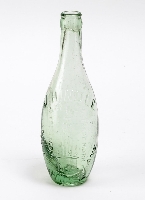 Soft drinks - bottled by design
Many shopkeepers were reluctant to store the drinks on their side to keep the cork wet, so manufacturers adopted a new shape devised by William Hamilton called the 'Hamilton Bowler'. This was egg-shaped with a rounded bottom preventing the bottle from standing upright. This shape came into general usage in 1840 and was used until the end of the nineteenth century.