The Scrimshanderer's Subjects
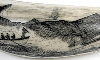
#SUBHEADING#The Scrimshanderer's Subjects#SUBHEADINGEND# Scrimshaw, objects created by carving and/or engraving the teeth and bones of whales and other marine mammals, features a wide variety of decorative motifs. Some images were drawn freehand, in particular those which drew from the sailor's own experiences. Others however were copied, often by pricking an outline through a template (a drawing or a print) which was pasted over the surface of the object to be decorated. #IMAGE##SUBHEADING#The Sea#SUBHEADINGEND# The sea was a major influence on the designs. The more adventurous and skilled artist would depict extravagant ships. As you would expect however, a familiar subject was the type of vessel on which they spent so much of their time. Some were portraits of just one ship at sea but there are many designs which depict a vessel or vessels amidst a hunt. Similarly, there are a number of illustrations which focus on the animals being hunted. Sometimes the designs were simple nature studies but often the creature is shown under attack. The men did not only rely on their seafaring experiences to inspire their work. Well known stories stimulated the sailor's imagination and unsurprisingly these tales often had a marine theme. #IMAGE##SUBHEADING#Myths and Legends#SUBHEADINGEND# Myths and legends also acted as inspiration and again the men appear to have mainly favoured marine themed tales. Here we see Neptune (Poseidon) who was god of the sea and Amphitrite, a sea nymph. The story goes that one day the god saw her dancing, fell in love with her and immediately asked her to marry him but she refused. A dolphin servant was then sent by Neptune to try and convince Amphitrite otherwise and it succeeded! As a reward, Neptune placed the image of the dolphin among the stars as the constellation Dolphinus. Biblical stories could also conjure images for the mens' artwork although examples which are as specific and detailed as this are rare. This design on a sperm whale tooth shows St John the Baptist at the mouth of a cave pointing to Christ and other figures. 'Behold the Lamb of God, which taketh away the sin of the World' is inscribed below. #IMAGE##SUBHEADING#Other Sources of Inspiration#SUBHEADINGEND# The sailors did not limit their subjects to stories and their seafaring experiences. Often we see depictions of fashionable ladies (sometimes accompanied by an equally fashionable gentleman). It is likely that the men copied images that they saw in magazines or fashion plates in books. Their loved ones at home no doubt also acted as inspiration in some instances and this can be seen in images such as this which depicts a woman reading and wearing more simple attire.
 Hull and the Whaling Industry
At its height Hull could boast one of the largest and most successful whaling fleets in Britain. Discover how it all began, how the whalers' braved arctic conditions to catch their whales and how the introduction of steam powered vessels signalled a decline for the Hull whaler.
 What is scrimshaw?
Sailors could be at sea for months at a time when searching the arctic seas for a catch. Inevitably they had time on their hands and a wealth of teeth and bones from marine animals at their fingertips - the result was the unique and fascinating craft of scrimshaw. Read on to find out more.
 Whaling
The first whaling ships left the port of Hull in 1598, soon after the discovery of Greenland. The industry was thriving by the early nineteenth century after many recessions and revivals. During the years 1815-1825 Hull had 2000 men employed in the trade and she could boast over 60 whaling vessels making it the largest fleet in Britain. Using our important collections to illustrate, this section of our website explores Hull's whaling history from its peak to its decline in the mid to late nineteenth century.