Thomas Sheppard
#SUBHEADING#Thomas Sheppard#SUBHEADINGEND# Thomas Sheppard was born on the 2nd October 1876 in South Ferriby, North Lincolnshire. One of ten children, both of his parents were teachers, he was a regular visitor to the museum of the Literary and Philosophical Society. Sheppard seems to have developed an interest in geology at an early age. His uncle, Thomas Havercroft was a local collector and taught Sheppard all he knew about collecting. In later years Havercroft helped begin the Municipal Museum's archaeology collection. Sheppard was only educated to elementary level and spent his last year as a pupil teacher. At the age of thirteen he became a clerk with the North Eastern Railway and later worked in the company's Dock Offices. Sheppard's work for the North Eastern Railway entitled him to free rail travel throughout East Yorkshire, giving him the opportunity to visit sites of geological interest across the region. #SUBHEADING#Geological Rambles#SUBHEADINGEND# As an eighteen year old Sheppard wrote a series of newspaper articles, subsequently re-published in 1903 under the title, 'Geological Rambles in East Yorkshire'. Sheppard also attended courses at the Natural History Museum in London and gained certificates in a wide range of natural history subjects. Sheppard was a member of numerous scientific societies and clubs and it is through these that he met John Robert Mortimer, a Driffield antiquary, who introduced Sheppard to prehistoric archaeology. Sheppard spent many afternoons at Mortimer's Museum in Driffield and in 1900 he produced 'Catalogue of the Mortimer Museum at Driffield'. During the late 1890's the future of Hull Literary and Philosophical Society's Museum was in jeopardy. Responsibility for the collections was eventually transferred to Hull Corporation in 1900 and Sheppard wrote to the Council urging them to appoint a curator. #SUBHEADING#Hull Municipal Museum#SUBHEADINGEND# Despite being only twenty-four years old and with little museum experience he was appointed curator on 15th January 1901 with a salary of one hundred and fifty pounds a year. Talking about his appointment Sheppard said "I was instructed to come to the museum at ten o' clock each morning, smoke my cigar...leave at four o'clock and if anybody wanted any information to give it to them, and if any gifts were made, to accept, but I had to incur no expense". However, it was made clear to Sheppard that the only reason the museum was there was to gain an art gallery. The first thing that Sheppard did was to close the museum for eighteen months and had it totally refurbished. He abolished admission charges when the museum re-opened on 2nd June 1902 and thereafter the museum never had fewer than 2000 visitors per week. He opened the museum two evenings a week between April and October and in 1908 opened the museum on Sunday afternoons. #SUBHEADING#A Life Devoted to Collecting#SUBHEADINGEND# During the next forty years Sheppard devoted his life to Hull's museums (he was awarded the title of Director of Museums in 1926) and by the time he retired in 1941 he was responsible for the opening of eight different museums A workaholic, alcoholic with a weak heart, Sheppard's health declined during the 1930's. His retirement in 1941 was marred by the destruction of many of his museums and collections during the bombings of the Second World War. Sheppard died at his home on the 18th February in 1945.
 History of the Ferens Art Gallery (part 1)
At the turn of the twentieth century Hull's art collections were housed in variety of locations. Thomas Robinson Ferens decided that a purpose built art gallery should be constructed and so work began on the Ferens Art gallery in 1926.
 History of Hull Museums (part 2)
The Museum of Commerce and Transport was opened on High Street in 1925 as the first of its kind in Britain. Sheppard was given the Old Corn Exchange building on High Street (now the Hull and East Riding Museum) to set up the museum, and persuaded local firms to carry out the work on the museum for free. It was filled with a transport collection which included carriages, trams, cars and a plane, some of which he begged from other museums.
 History of Hull Museums (part 1)
This story looks at the origins of the Council's Museum service which began in 1900 when it took over responsibility for the collections developed by the Literary and Philosophical Society. The following year saw the appointment of Thomas Sheppard as its first curator and began a period of rapid growth and development.
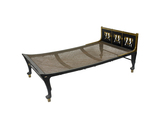 The Tutankhamun Replicas
The discovery of the tomb of Tutankhamen had caught the public imagination, leading to a widespread 'Tutmania' and a popular craze for all things Egyptian. Discover how a replica tomb was created at the British Empire Exhibition of 1924 - much to the annoyance of Howard Carter.
 The Tutankhamun Replicas at Hull Museums
Howard Carter had never seen the replicas, and they were far better reproductions than he gave them credit for. Read on to find out how long it took William Aumonier to complete the replicas and how they came to be in Hull Museums Collections.