Games are Prohibited Here!
#IMAGE# Throughout the centuries many games have faced moral and religious restrictions and have been outlawed. In ancient Egyptian times, games and sports, that were more physical, were criticised as they were classed as too dangerous. The Egyptians believed that their bodies were very precious and if they were damaged, could stop them becoming immortal in the afterlife. Also wealthy Egyptians thought that games that made them develop muscles belonged to the lower classes who had to do physical labour. The Egyptians felt that being overweight symbolised success and wealth. In Roman times most games of chance (except gambling on physical sports) were strictly forbidden by Roman law. They were punishable with a fine that would be four times the amount of money that was gambled. However it was widely known that most 'caponulae' and 'popinae' (inns and eating houses) welcomed secret game playing in their back premises. There are images of this in wall paintings from Pompeii. In Medieval times many board games and pub games such as billiards and skittles were played for money, because of this they became unpopular with the authorities in England in the 13th and 14th Century. Until the reign of Elizabeth I in 1559, laws prohibiting the playing of games in licensed establishments were in force. Pub games again were banned from taverns later in 1757 due to their seedy reputation. #IMAGE# In the 1640's there was a Civil War between the forces of King Charles I and Parliament. After Parliament's victory laws were passed against Sunday games as many in parliament were Puritans. In some areas people were even arrested for playing football! However it was very hard to make people obey the laws. For instance, just before Shrove Tuesday in 1660 the Bristol authorities announced a ban on 'cock-throwing, dog-tossing and football'; as a consequence the people of Bristol rioted. There have even been restrictions on games such as skipping and marbles. In Britain there was a religious tradition of game playing which used to begin on Ash Wednesday through to Good Friday. After that day, games such as marbles and skipping were strictly taboo and boys and girls, who attempted to play them, were liable to have their toys confiscated with the cry 'Goblins after Good Friday!' #IMAGE# There have been great attempts in history to banish the playing of games on Sundays and during religious holidays. Any association between the enjoyment of games and religion was and is greatly criticised. In our collections there is a document describing an incident where a soldier has dared to take a pack of cards into church. Luckily he cleverly thinks of a story to escape a harsh punishment from the Mayor, bravely and audaciously managing to compare his pack of cards to his bible and prayer book! Victorians also looked upon games played on Sundays harshly. A printed notice of a Royal proclamation in our collections shows Queen Victoria's stance at game playing on Holy days. On the notice you can see that the rule regarding this is repeatedly mentioned. #IMAGE# In Victorian times more toys were made to teach and give moral instruction. There were games such as 'Virtue rewarded and vice punished' that tried to teach good behaviour and 'What d'ye buy' that compared different shops and tried to teach children the value of money. Children centuries earlier, had been classed as adults at a much earlier age. Children as young as twelve were answerable to the law and could play adult board and dice games that involved money. However in Victorian times it was believed that children should not play with dice because they were associated with gambling so instead they used teetotums, numbered spinning tops to determine the number of throws.
 Home and Leisure Life
This section contains stories about what people used to do in their leisure time and about their homes. People have always played games since ancient times. Some stories explore the types of pastimes there once were. Leisure time was not just about playing games. Sewing at home was once a very popular hobby. One story is about the Singer sewing machines that were often used. Leisure activities that took place outside the home included watching puppet theatres. Two stories take a look at what everyday items in the home are made from, including toothpaste!
 Board games - Boards and Counters
The history of toys and games goes back thousands of years. Throughout Hull's museum collection's there are many objects to show you the different kinds of games that were played in Britain and how they have developed through the centuries. See how this has happened, sometimes in the strangest of places - Come and play!
 Board Games - The Roll of Knucklebones and Dice Throughout History
The history of toys and games goes back thousands of years. Throughout Hull's museum collection's there are many objects to show you the different kinds of games that were played in Britain and how they have developed through the centuries. See how knucklebones and dice were important in this development - Come and play!
 The Survival of Games - War Games
The history of toys and games goes back thousands of years. Throughout Hull's museum collection's there are many objects to show you the different kinds of games that were played in Britain and how they have developed through the centuries. See the creation of War Games - Come and play!
 The Survival of Games - Hunt and Race Games
The history of toys and games goes back thousands of years. Throughout Hull's museum collection's there are many objects to show you the different kinds of games that were played in Britain and how they have developed through the centuries. See the creation of Hunt and Race Games - Come and play!
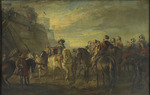 1640 Charles I visits Hull
In 1639 Charles I (1625-1649) visited Hull, whilst on a journey from London to York. During the 1630s Hull had become heavily fortified, with much ammunition stored there, because the King's relations with Scotland were deteriorating, and war seemed inevitable.
 Hull & Barnsley Railway Albums
Wonderful photographic images of the construction of the Hull & Barnsley Railway, now available to view on our collections website.